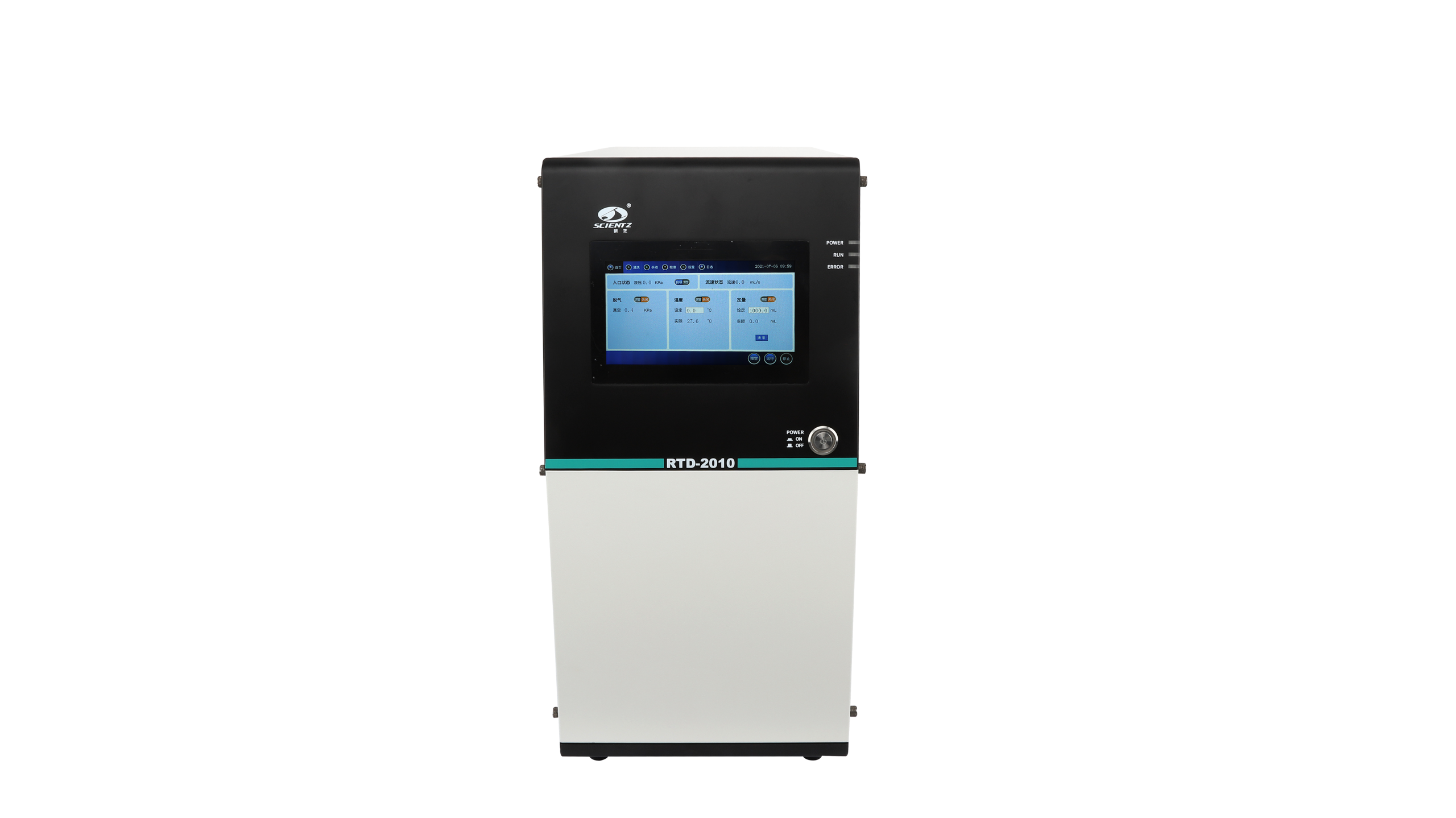
RTD-2010 Real-Time Constant Temperature Degassing Instrument
2.1 Performance parameters
2.1.1 Heating range : room temperature -45.0 ℃
2.1.2 Temperature resolution: 0.1 ℃
2.1.3 Temperature control accuracy: ± 1 ℃
2.1.4 Flow resolution: 0.1mL
2.1.5 Flow control accuracy: ≤±1 %
2.1.6 Removal rate : ≥85%
2.1.7 Degassing membrane pore size: 300μm OD/220μm ID
2.1.8 Degassing membrane area: 0.58m² ID
2.1.9 Count of hollow fiber membrane: 7400
2.1.10 Porosity: 40% Porosity
2.1.11 Silk film material: Polyurethane
2.1.12 Degassing rate: ≤1000mL/ Min
2.1.13 Vacuum resolution: 0.1K p a
2.1.14 Vacuum degree: ≤ – 90K p a
2.1.15 Target oxygen content: ≤2.8mh /L
2.1.16 Logging function, can audit trail
2.2 Instrument indicators
2.2.1 Input power: 220Vac±10% 1100W
2.2.2 Overall size: 260x530x560mm
2.2.3 Overall weight : 23K g
2.2.4 EMC : IEC6100-4-2 , IEC6100-4-4, IEC6100-4-5, IEC6100-4-11
2.2.5 Operating temperature :5~40℃
2.2.6 Storage temperature: -20~60℃
2.2.7 Working humidity: 20~80% RH
2.2.8 Storage humidity: 5 ~95% RH
2.3 Features of the instrument
2.3.1 Treatment medium: it can directly deal with solvents, pure water, distilled water, etc. commonly used in dissolution experiments;
2.3.2 Accuracy of liquid output: Automatically complete quantitative liquid feeding, preheating, degassing and quantitative liquid discharge, and the volume control accuracy of liquid output volume can reach ± 1% , which can be directly added to the dissolution vessel, avoiding quantitative re-introduction in the middle. bubble.
2.3.3 On -line heating: The heating can be set in the range of room temperature -45.0 ℃, and the temperature control accuracy can reach ± 1 ℃, which saves the heating waiting time of the dissolution medium in the dissolution apparatus.
2.3.4 Selection of liquid inlet: The instrument automatically recognizes self-priming or external pressure through the hydraulic detection of the liquid inlet, and automatically switches the flow path to achieve degassing. Customers can connect the liquid inlet to the purified water faucet to operate directly, eliminating the need for The intermediate process is improved, and the work efficiency is improved.
2.3.5 Record : With log function, the operation time of the instrument operation record and other contents are stored in the storage device that comes with the instrument, and can be audited and tracked, and cannot be modified or deleted.
2.3.6 Comply with Chinese Pharmacopoeia 2020 standard for preparation of dissolution medium.
2.3.7 The combination of heating , vacuum and circulation makes degassing more thorough and rapid.
2.3.8 Color touch screen, the parameters are clear at a glance, and the operation is fast and quick.
2.3.9 Equipped with hydraulic detection, which can realize automatic switching between self-priming and external pressure.
installation requirements
3.1 Environmental requirements
3.1.1 RTD-2010 real – time constant temperature degassing instrument should be placed in a dedicated working space, and there should be no harmful, flammable and corrosive gases nearby.
3.1.2 Operating temperature: The limit working temperature is (5~40) ℃, and the indoor temperature should be ( 15~25 ) ℃ during normal operation.
3.1.3 Storage temperature: (-20~55) ℃
3.1.4 Ambient relative humidity: ( 20 ~80) % RH
3.2 Placement requirements
RTD-2010 real-time constant temperature degassing instrument should be placed in a horizontal, flat and stable position. Because it is a liquid handling instrument, water leakage and splashing may occur. Pay attention to electricity safety; the inlet and outlet of the instrument flow path are on the left side of the instrument There should be at least 30cm space on the side and left side to ensure the experimental operation. The power inlet of RTD-2010 real-time constant temperature degassing instrument is located at the rear of the instrument, please ensure that the distance between the power socket and the inlet is no more than 1 meter.
3.3 Power Requirements
A set of (220±20) V AC, 10A, 50/60Hz, protective grounded single-phase power supply is required to power the instrument; the PE grounding of the power supply must be reliable to ensure the normal operation of the instrument and avoid electric shock to the human body. The grounding resistance of the ground wire is required to be less than or equal to 0.1 ohms.